
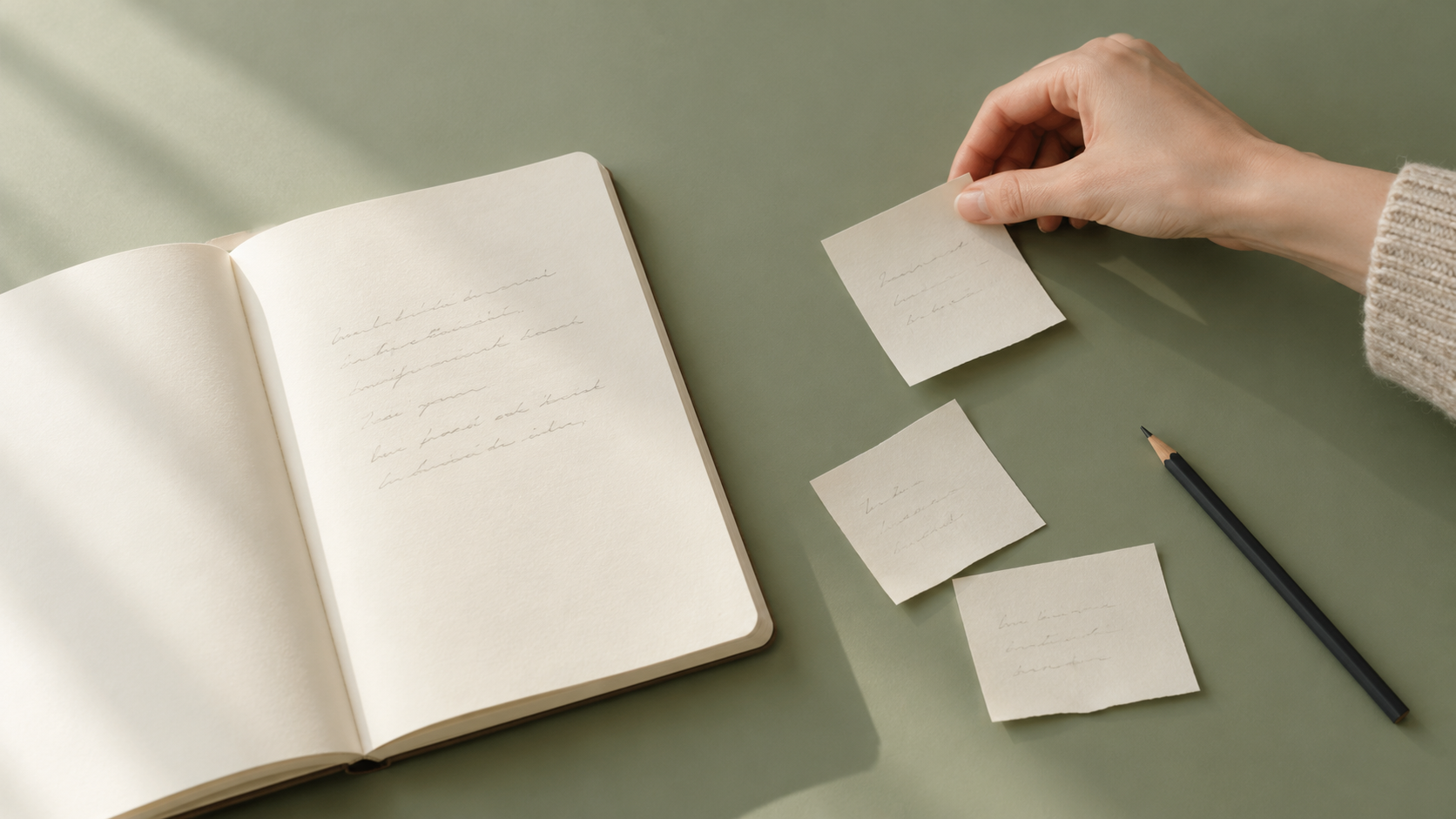
You open your list to remember one thing and find twenty others waiting. Call the dentist. Try that recipe. Reply to an old message. Learn something useful. Sort out the drawer. Somewhere between a real appointment and an idea you saved three months ago, everything has begun to look equally unfinished.
Writing things down can give a thought somewhere to live outside your head. But a list can also become crowded with items that were never commitments in the first place. When every reminder looks like a task, even checking the list can add pressure. If ordinary tasks already feel unusually heavy, read why small tasks can feel impossible when your mind is already full.
To lighten your mental load, begin with one question: Does this still need something from me? You do not need to reorganize your whole life to answer it.
A reminder is information, not automatically an instruction
A note can mean several different things. It may record a promise, hold a useful detail, preserve an idea, or remind you of something that mattered in another season. Those are different jobs. They do not all belong on today’s list.
“Submit the form by Friday” needs a clear response. “A restaurant I might like” needs somewhere to be found if you want it. “Become someone who makes bread every weekend” may be an attractive possibility rather than a responsibility. Putting them beside one another does not make them equally necessary.
Before treating an item as work, ask whether you agreed to do it, whether someone is reasonably relying on you, and whether there is an actual consequence or deadline. A thought appearing repeatedly is not, by itself, a deadline.
Look at one small corner, not the whole backlog
Choose a short section of one list: perhaps five lines, a handful of saved notes, or the reminders visible without scrolling. Leave the rest alone. This is not a new weekly review you must maintain.
For each item, ask what it is asking you to hold. Is there an action? Is it useful information? Is it only a possibility? Or has the reason for keeping it disappeared? You can answer in ordinary language without creating folders, color codes, or a better app.
If even looking at the list feels too much, stop after one item. The 10-minute reset for a crowded mind offers a broader pause when several kinds of mental noise are competing. This smaller practice is simply about checking whether an old reminder still belongs.
Give useful information a place that does not demand action
Imagine that “ask about the class” has been on your list since summer. The class is no longer running. You might still want to keep the teacher’s name, but the original task has expired. Save the detail somewhere you would naturally look for it, then remove the outdated instruction.
Or you have saved a recipe because it looked good. You can keep it with recipes instead of carrying “make this” as unfinished work. Interest does not need to become an assignment to justify itself.
Use a place you already have, such as an existing notes page or a bookmark. If moving an item creates more work than it is worth, you can leave it where it is and simply recognize that it is optional. You are clarifying its meaning, not performing a perfect cleanup.
Check before you release a real commitment
Some reminders do represent responsibilities. Bills, medical instructions, work deadlines, and promises to other people need more care than a saved idea. Do not delete something important just because it feels heavy.
If an obligation no longer fits your capacity, the next step may be to renegotiate it, ask for help, or confirm that it is no longer needed. For example: “We discussed this last month. Is it still required?” A completed or canceled task can leave the list after you have checked its status.
An optional intention can be released quietly. A shared commitment may need a conversation. Knowing the difference lets you reduce pressure without creating a problem for your future self or someone else.
You can change your mind about an old intention
An old list sometimes preserves a version of you who had different time, energy, or priorities. You planned to take a course, refresh every room, or read every article you saved. Keeping all those possibilities active can make the present feel permanently behind.
You can ask: “Would I choose this again now?” If the answer is no, and no real obligation remains, you are allowed to let the item go. You do not have to complete it first or write an explanation for why it stayed unfinished.
If you are unsure, leave it undecided. The point is not to force a decision about everything. Finding one item that no longer needs action is already useful.
Stop before the cleanup becomes another demand
Finish after your small section. You do not need an empty list, and you do not need to use any space you created to add more tasks. Notice whether the list now represents your actual responsibilities a little more honestly.
If your list is accurate but still too large for one day, the next step is different. Read how to rest when your to-do list is still full for help stopping without waiting for everything to be complete.
Make a little more room in your mind
Declutter Your Mind by Emily Carter explores mental noise, unfinished thoughts, and the quiet weight of carrying too much. It offers gentle practices for creating space without turning clarity into another project.
Let the list describe your life, not judge it
A reminder can help you remember. It does not get to decide what kind of person you should become. Keep what protects a real responsibility. Let useful information remain information. Allow an old possibility to stop asking for your attention.
Today, one line may be enough: “This no longer needs doing.”
This article is for general informational and educational purposes only. It is not medical advice or a substitute for professional mental health care. If mental overload is persistent, severe, or affecting everyday functioning, consider speaking with a qualified professional.