
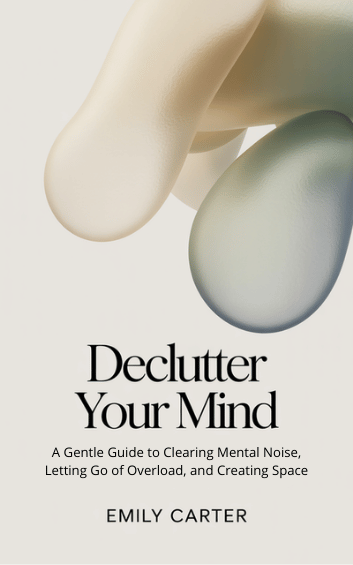
A gentle guide by Emily Carter
Declutter Your Mind
A gentle guide to mental noise, open loops and the quiet weight of carrying too much at once.
You do not need an empty mind. You need fewer things competing for space.
Is this book for you?
Mental clutter is not always loud. It can sit quietly in the background: reminders, unfinished thoughts, worries you may need later and emotional residue from situations that have already ended.
This guide may help if you:
- feel mentally crowded even when no single problem is urgent;
- carry many unfinished tasks and open loops in your head;
- make more lists but still do not feel lighter;
- hold responsibility for other people’s feelings or outcomes;
- want mental space without forcing yourself to feel calm or clear.
Declutter Your Mind distinguishes mental clutter from ordinary thinking and from overthinking. Overthinking loops around one issue; mental clutter is accumulation. It does not spin so much as weigh.
What mental decluttering really means
The goal is not to organize every thought or create a perfectly silent mind. It is to decide what deserves attention, what can be set down temporarily and what no longer belongs in your mental space.
- recognize unfinished tasks, background worries and emotional residue;
- separate mental load from mental clutter;
- release thoughts without resolving every one of them;
- reduce inputs and stop treating clarity as another demand;
- notice what you are carrying that is not actually yours;
- create a simple return point when the clutter comes back.
Inside the book
The book begins by explaining why a mind can feel full even after physical rest and why trying to remember, sort and systematize everything may add pressure. It then identifies different kinds of clutter and shows why each needs a different response.
The practical chapters offer seven short, low-effort practices, a one-line method for getting thoughts out of your head without reflective journaling, ten release prompts and an exercise for separating emotional responsibility from actual responsibility.
“Clearing your mind doesn’t mean emptying it. It means reducing what you’re carrying.”
You can use one practice at a time. The exercises are not a maintenance system and do not need to become another set of habits to manage.
Read this first
A 10-Minute Reset for a Crowded Mind
Try this short practice when your mind feels full and you need a little space before deciding what deserves your attention next.
Questions readers often ask
Is this another productivity system?
No. The book does not ask you to track, categorize or optimize every thought. It focuses on releasing unnecessary mental content, not managing more of it.
Do I need to journal?
No. The workbook includes a one-line external drop and other practices for readers who find traditional journaling tiring or likely to create more analysis.
Will the mental clutter come back?
Probably — because life keeps adding inputs and responsibilities. Return is not regression. You can use one familiar cue or question without repeating the whole book.
You do not need a clear mind.
You need enough space to know what deserves your attention now.