
You may know that you need rest and still feel unable to take it. The list is unfinished. A message is waiting. The kitchen is not quite reset. Tomorrow already has too many moving parts. Sitting down can feel less like relief and more like ignoring evidence.
This is one of the quiet problems of an overloaded life: rest begins to feel permitted only after everything is complete. But most adult lives do not offer a clean finish line. There is nearly always one more useful thing you could do.
Learning how to rest with unfinished tasks is not about becoming careless. It is about recognizing that recovery is part of carrying responsibility—not a reward you receive when responsibility disappears.
Why an unfinished list keeps you mentally standing
A to-do list is not only a record of tasks. It can also become a record of promises, expectations, and possible consequences. “Send the email” may secretly mean “do not disappoint anyone.” “Clean the kitchen” may mean “prove that you are keeping up.” No wonder putting the list down can feel uncomfortable.
Your mind may continue rehearsing unfinished tasks because it is trying to keep them available. It repeats them so they will not be forgotten. That mental repetition can create the impression that staying tense is the same as staying responsible.
It is not. Tension does not complete the task. It only makes the unfinished task occupy the time that was meant to restore you.
Decide what “enough for today” means
If your stopping point is “when everything is done,” you may never reach it. A more realistic stopping point is based on capacity rather than completion.
Before the evening disappears into one more task, ask:
- What genuinely cannot wait until tomorrow?
- What would be useful, but is not urgent?
- What am I doing only because stopping feels uncomfortable?
Choose a small definition of enough: the necessary message sent, tomorrow’s first step identified, and one basic need met. The rest can remain incomplete without becoming abandoned.
Give unfinished tasks a return time
“I will deal with this later” can feel vague, and a tired mind does not always trust vague promises. Give the task a clear place to return.
You might write:
- “Open the document at 9:30 tomorrow and write the first paragraph.”
- “Call the clinic during Tuesday’s lunch break.”
- “Look at the household list on Saturday morning—not tonight.”
A return time tells your brain that the task has not vanished. It has been placed somewhere. You do not need to keep it active in your body to prove that it matters.
If several thoughts are competing for attention, the 10-minute reset for a crowded mind can help you separate today’s needs from everything that can wait.
Use a closing action, not a perfect routine
You do not need an elaborate evening ritual. One small closing action can mark the change from doing to resting.
- Close the laptop and place it out of reach.
- Write tomorrow’s first task on one line.
- Turn off the main light and use a smaller lamp.
- Put away the notebook instead of leaving it open beside you.
The action does not need to create instant calm. Its job is simpler: to show that the working part of the day has ended.
Let rest be small enough to begin
Sometimes “rest” sounds like a large commitment: an empty evening, a long bath, an early night, a weekend with no obligations. When none of that is available, you may decide that rest is not available either.
Make it smaller. Ten minutes with no input. A cup of tea without answering messages. Sitting down before you decide what comes next. A shower without mentally organizing tomorrow.
A short pause will not repay every hour of exhaustion. But it can interrupt the habit of moving directly from one demand into another.
Expect discomfort at first
If you are used to earning rest through productivity, stopping early may not feel peaceful. You may feel guilty, restless, or tempted to get up and complete one more thing.
That discomfort does not prove that you should continue. It may simply be the feeling of doing something unfamiliar.
Try a sentence that does not argue with the list:
- “This is unfinished, and I am finished for today.”
- “I can care about this without working on it tonight.”
- “Rest will help me return with more capacity.”
If the list becomes especially loud after bedtime, read why your thoughts feel louder when the day finally gets quiet. The problem is often not the silence itself, but everything that had no room to be noticed earlier.
Do not turn tomorrow into a punishment
Resting tonight does not require making tomorrow impossibly efficient. Avoid responding to an unfinished day by building an overloaded plan for the next one.
Choose one starting point for tomorrow and leave space around it. If small tasks already feel strangely heavy, this guide to why small tasks feel impossible may help you understand what your capacity is trying to tell you.
You are allowed to stop before the list ends
An unfinished list is not evidence that the day was wasted. It is evidence that your life contains more possibilities and responsibilities than one day can hold.
Record what needs to return. Name what was enough. Close one physical object connected to work. Then let rest begin before you feel completely ready for it.
A gentler way to reset your pace
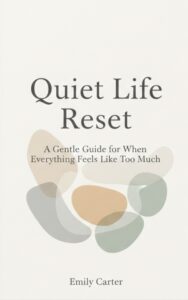
Quiet Life Reset by Emily Carter offers calm, practical support for slowing down, reducing everyday overload, and creating routines that leave room for recovery—without asking you to rebuild your entire life.
This article is for general informational and educational purposes only. It is not medical advice and is not a substitute for professional mental health care.