
Sometimes the task is genuinely small.
Reply to one message. Put away one item. Make one appointment. Open the document. Decide what to eat.
You know it should not be difficult. That knowledge does not help. In fact, it often makes the moment heavier, because now you are carrying the task and the judgment that you should already have done it.
When small tasks feel impossible, the size of the task may not be the real issue. It may simply be the next thing arriving in a mind that is already full.
The task is small. The load behind it may not be.
A single email can contain more than one action. You need to remember the context, decide what to say, consider how the other person may respond, choose the right tone, and leave yourself open to whatever comes next.
Making an appointment can mean checking dates, anticipating travel, deciding whether the problem is “important enough,” and adding another commitment to a week that already feels crowded.
Even choosing dinner can become difficult when you have spent the day making decisions for work, family, other people, and your future self.
From the outside, these are ordinary tasks. From the inside, they may be the visible edge of a much larger mental load.
Why pushing harder often makes starting harder
When you cannot begin, the usual response is pressure:
- “Just do it.”
- “This will only take five minutes.”
- “Why am I making such a big deal out of this?”
These thoughts are meant to create movement. Instead, they add another layer of demand.
Now you are not only trying to complete the task. You are also trying to prove that you are capable, responsible, and not wasting time. The task becomes a small test of your character.
That is far too much meaning for one email to carry.
Three different reasons a small task can feel impossible
1. The task is not clearly defined
“Deal with the paperwork” is not one action. It may mean finding a document, reading it, making a decision, asking a question, scanning something, and sending a reply.
Your mind may resist because it cannot see where the task begins or ends.
2. The task opens another door
Some tasks do not feel difficult because of the work itself. They feel difficult because completing them creates a response, commitment, conversation, expense, or decision you do not have capacity for.
You may not be avoiding the message. You may be avoiding everything that could follow it.
3. Your available capacity is already spoken for
A glass can hold one more drop only when it is not already full. Mental capacity works in a similar way. The final request may be tiny, but it still has nowhere to land.
This does not tell you exactly why your capacity is low. Stress, poor sleep, emotional strain, physical health, caregiving, uncertainty, grief, anxiety, depression, ADHD, and many other circumstances can affect daily functioning. A single article cannot diagnose the reason — and neither should a harsh inner voice.
Try reducing the entry point
Instead of asking, “How do I finish this?” ask:
“What is the smallest honest beginning?”
Not a trick version of the whole task. Not “complete the report” disguised as “work on the report.” A real beginning might be:
- put the document where you can see it;
- write the recipient’s name;
- find the phone number without calling;
- open the form and read only the first question;
- write one sentence explaining what feels unclear.
You are allowed to stop after that beginning. Sometimes momentum appears. Sometimes it does not. The purpose is not to manipulate yourself into finishing. It is to make contact with the task without flooding the little capacity you have left.
Remove one invisible demand
If beginning still feels impossible, reducing the task may not be enough. Something else may need to leave.
Ask:
- Can this wait until tomorrow?
- Can someone else make this decision?
- Can I give a shorter answer?
- Can I choose “good enough” before I begin?
- Do I need to do this at all?
Overwhelm is not always solved by arranging the same number of demands more efficiently. Sometimes relief comes from carrying fewer of them.
A five-minute gentle reset
- Name the one task that feels disproportionately heavy.
- Write down what completing it might lead to.
- Separate the first physical action from everything that follows.
- Choose whether to begin, reduce, delegate, or delay.
- Stop judging the choice for the next five minutes.
This is not a productivity technique. It is a way to lower the amount of pressure attached to one small moment.
When the problem feels bigger than one task
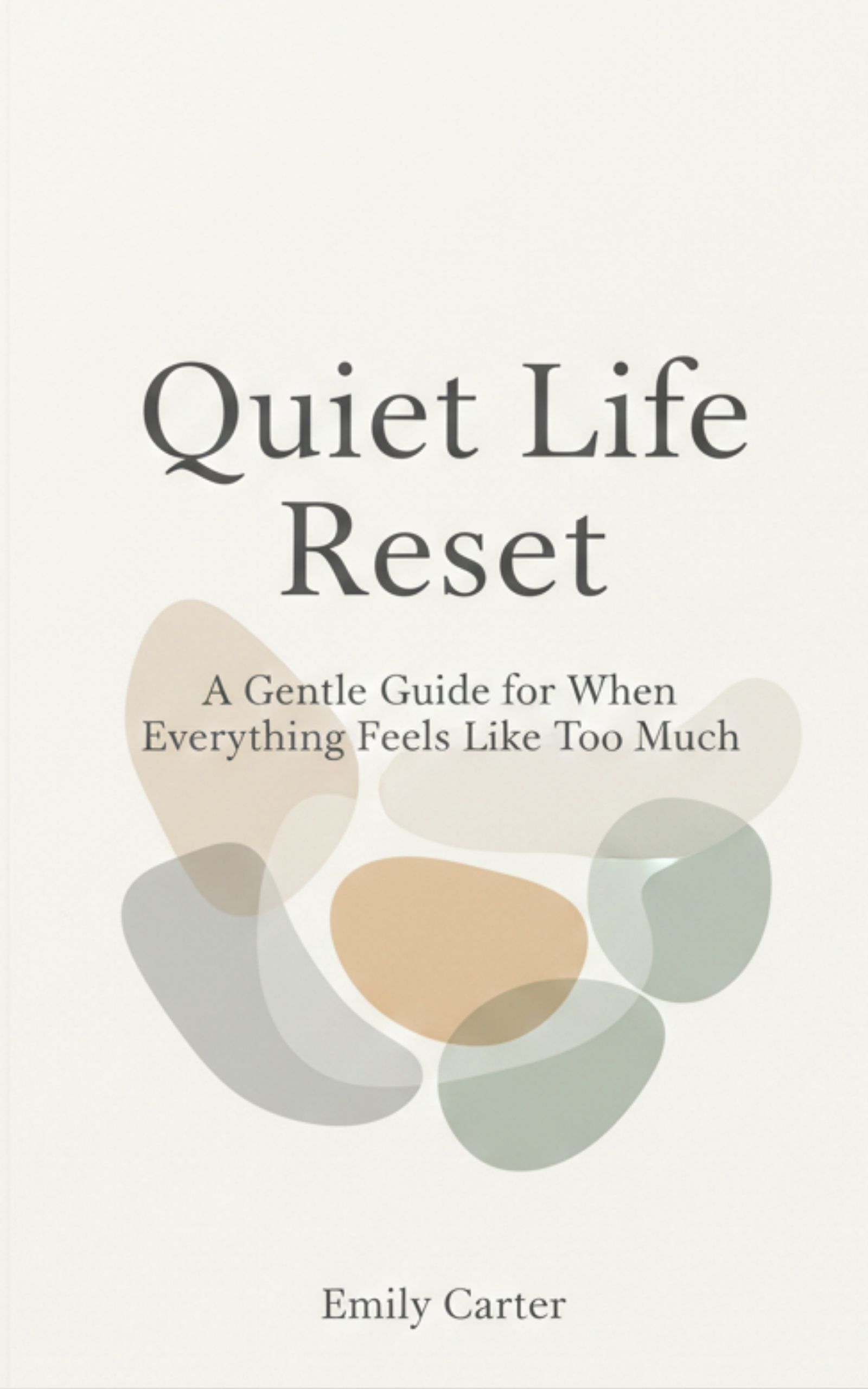
If many ordinary parts of life have started to feel heavy, Quiet Life Reset offers a wider, gentler look at overload, quiet burnout, decision fatigue, boundaries, and reducing expectations without rebuilding your entire life.
You are not required to earn an easier beginning
A small task feeling difficult does not prove that you are lazy. It tells you that something about the task, the consequences around it, or your current capacity needs attention.
You do not have to answer that information with force. If the wider feeling is that everything has become too much, begin with the quieter introduction to this space or explore the full collection of gentle guides by Emily Carter.
You can begin smaller. You can reduce what follows. You can delay what is not urgent. You can ask for help. And sometimes, you can decide that one more thing does not need to happen today.
This article is for educational and inspirational purposes and is not a substitute for medical, psychological, or professional advice. If difficulty with everyday tasks is persistent, severe, or affecting your safety or daily functioning, consider speaking with a qualified professional.