
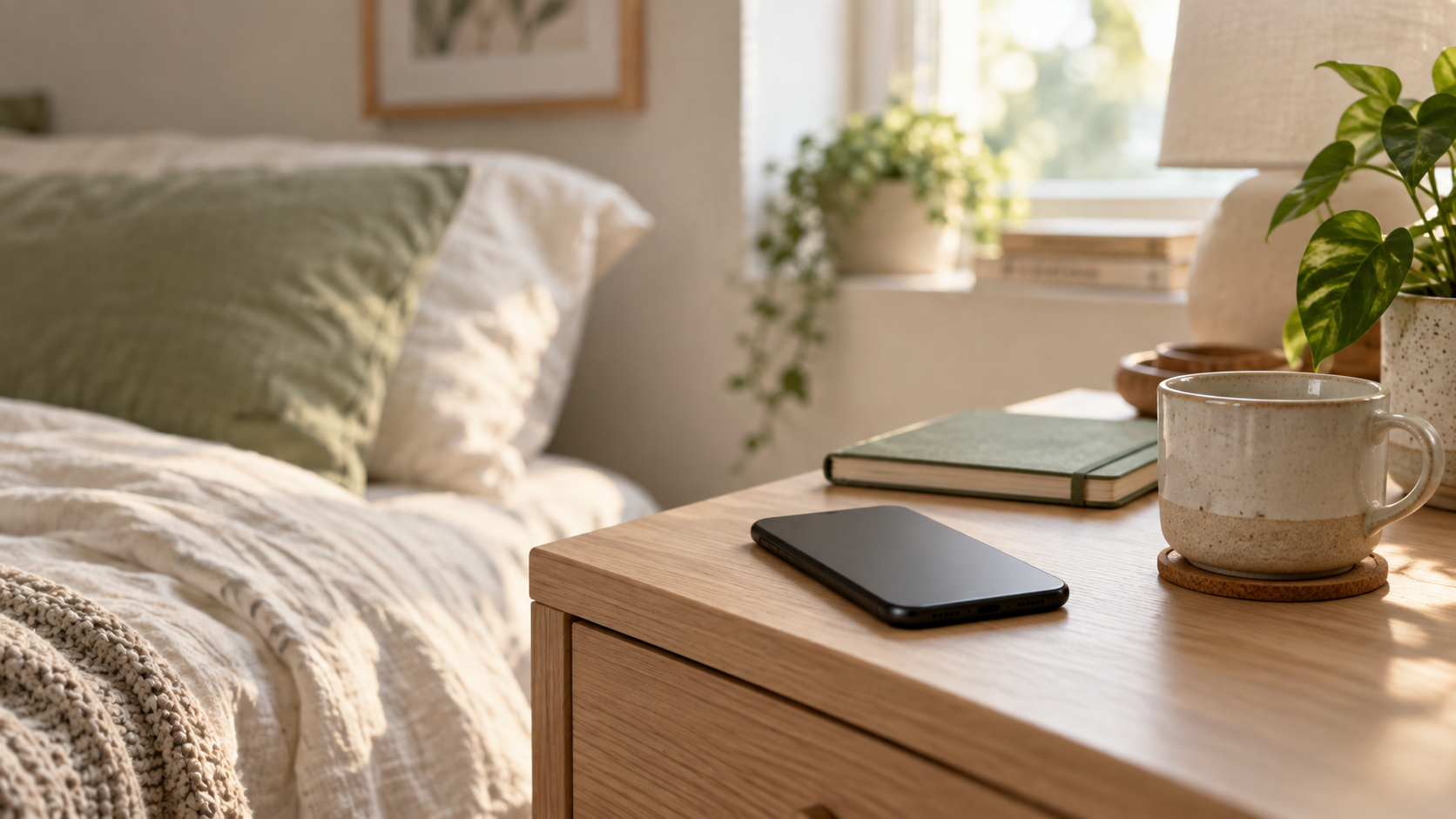
You pick up your phone to check one thing.
A few minutes later, you are in another app, reading something you did not intend to open. The original reason for reaching for the phone has disappeared, but your attention has gone with it.
If this happens often, the usual advice can feel extreme: delete every app, turn the screen grey, block social media, or begin a full digital detox. Those changes may help some people. But many of us need our phones for work, family, maps, banking, appointments and ordinary connection.
The goal does not have to be using your phone as little as possible. A more realistic goal is to notice the automatic reach and create a small space in which you can choose what happens next.
Why checking your phone becomes automatic
Phone habits are not only about notifications. You may reach for the screen when you are bored, uncertain, tired, between tasks or about to begin something uncomfortable.
The phone offers an immediate transition. It fills a quiet moment before you have to decide what to do with it. It can also postpone an awkward feeling: the effort of starting, the emptiness after finishing, or the discomfort of waiting without knowing what will happen next.
This is why simply promising to “have more self-control” often fails. The phone is already performing a function. If you remove the behaviour without noticing what it replaces, the same moment still needs somewhere to go.
Start with one problem moment
Do not begin by trying to change your entire day. Choose one recurring moment when phone use leaves you feeling less rested, more scattered or slightly disappointed.
For example:
- the first ten minutes after waking;
- the moment you sit down to begin a task;
- waiting in a queue or parked car;
- checking during a conversation or television programme;
- scrolling in bed after you intended to sleep;
- picking up the phone every time work becomes difficult.
A specific moment is easier to change than the vague instruction to “use your phone less.”
Ask what the phone is doing for you
Before setting a boundary, look at the moment without judging it.
Ask:
- What happened just before I reached for the phone?
- Was I looking for information, relief, stimulation or delay?
- Did I choose a purpose, or did my hand move before I decided?
- How did I feel five minutes later?
You may discover that the habit is not mainly about the app. It may be about avoiding a beginning, escaping a pause, checking for reassurance or giving an exhausted mind something effortless to follow.
Create distance instead of demanding discipline
A useful boundary often changes access rather than trying to eliminate desire.
You might:
- leave the phone across the room while eating;
- charge it outside the bedroom;
- keep it in a bag during one part of the day;
- remove one distracting app from the home screen;
- turn off only the notifications that create false urgency;
- open the phone after naming what you are there to do.
These changes create a little friction. The point is not to make phone use impossible. It is to give your intention enough time to catch up with your hand.
Use a purpose sentence
Before unlocking the screen, finish this sentence:
“I am opening my phone to…”
The answer might be “reply to Anna,” “check the train time,” or “spend ten minutes looking at Instagram.” Browsing is allowed. The difference is that it becomes a choice with a beginning, rather than a doorway you walked through without noticing.
When you have completed the purpose, you can choose again. You do not need to leave the phone immediately, but the next action is no longer pretending to be the first one.
Protect a moment, not a perfect streak
Many phone rules become exhausting because they depend on never breaking them. One late-night scroll is treated as proof that the whole plan failed.
Try protecting one moment instead:
- breakfast without the phone on the table;
- the first five minutes of a work task;
- one walk without checking;
- the final fifteen minutes before sleep.
A boundary can be useful even if it works four days out of seven. You are building a different option, not proving that you are perfectly disciplined.
Decide what will replace the reach
If the phone usually fills a transition, prepare one small alternative. Look out of the window. Stretch. Drink water. Write the next physical step of the task. Let the quiet moment remain quiet for thirty seconds.
The replacement does not need to be impressive or productive. It only needs to give the pause somewhere else to land.
If your mind feels too crowded to choose what comes next, try the 10-minute reset for a crowded mind. If the phone is only one part of a wider sense of overload, read why small tasks feel impossible when your capacity is already full.
Build boundaries that fit real life
Phone Boundaries Workbook by Emily Carter helps you understand automatic checking, identify the moments that need protection and test realistic physical, time and attention boundaries without a strict digital detox.
A boundary is an experiment, not a verdict
If you break the rule, look at what happened. Was the phone too close? Was the boundary too broad? Were you tired, waiting or trying to avoid something difficult?
That information helps you adjust the environment. It does not prove that you lack discipline.
Choose one moment, add one small piece of distance and notice what changes. Your phone can remain part of your life without automatically filling every pause inside it.
This article is for educational and inspirational purposes and is not a substitute for medical, psychological or professional advice.