
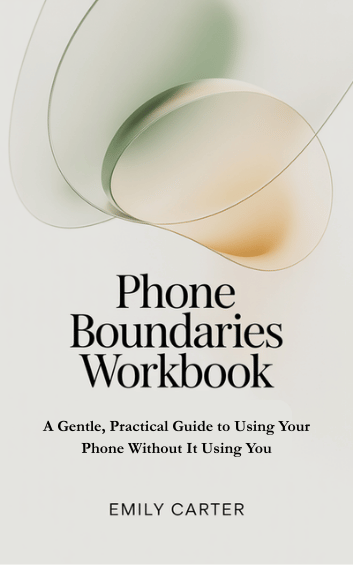
A gentle workbook by Emily Carter
Phone Boundaries Workbook
A realistic guide to using your phone without letting it quietly shape every pause, transition and evening.
No digital detox. No shame. No demand that you become perfectly disciplined.
Is this book for you?
Most phone use does not begin with a decision. Your hand reaches for the screen before you fully notice — in a quiet moment, before starting a task, after finishing one, or whenever discomfort appears.
This workbook may help if you:
- pick up your phone automatically and then wonder why you opened it;
- lose small pockets of rest to scrolling, checking or switching between apps;
- feel constantly reachable even when no message is urgent;
- want better focus without deleting every useful app;
- have tried strict rules that lasted briefly and ended in guilt.
The phone is not treated as the enemy. The aim is to understand what it currently replaces — pauses, transitions, starting, stopping or simply being present — and decide where a boundary would genuinely support you.
What a phone boundary really is
A useful boundary is not a punishment. It is a quiet agreement about when your phone helps and when it fragments your attention. The workbook focuses on boundaries that are small enough to survive real life.
- notice emotional and situational triggers before changing anything;
- reduce access rather than trying to eliminate desire;
- use physical boundaries, such as where the phone lives;
- protect specific moments instead of counting every minute;
- choose one purpose at a time when you pick up the device;
- adjust a boundary when it does not work instead of blaming yourself.
Inside the workbook
The early chapters explain how habits form in neutral moments, why notifications are not always the real trigger and how constant availability drains attention and energy. Later sections move into practical physical, time and attention boundaries.
You will create a snapshot of your current phone use, choose a single low-resistance boundary and test it as an experiment. The workbook includes a simple experiment log, guidance for moments when you break your own rule and a gentle plan for rebuilding trust with yourself.
“Phone boundaries are not punishments. They’re agreements you make with yourself about when your phone is helpful — and when it isn’t.”
You do not need to use your phone less in every part of your life. You need clearer choices around the moments that currently feel automatic, draining or crowded.
Read this first
How to Stop Checking Your Phone Without a Digital Detox
Start with one recurring moment, understand what the automatic reach is doing for you and try a realistic boundary without deleting every useful app.
Questions readers often ask
Do I have to do a digital detox?
No. The workbook is designed around ordinary phone use. It helps you decide when the device is useful and when a little distance would protect your attention.
Do I need to follow every boundary?
No. Start with one problem moment and one low-resistance experiment. Boundaries may be temporary and should be adjusted when your circumstances change.
What if I break my own rule?
That is information, not failure. Look at the trigger, the moment and the amount of resistance. Then make the boundary easier to use rather than making yourself the problem.
Your phone can stay. The automatic reach can change.
Begin with one moment you would like to get back.